Audio Has the Hours Your Other Channels Can't Reach#
Here is a small thought experiment. Picture a typical Wednesday for one of your better customers. They wake up, get the kids ready, drop them off, drive to work, sit through a couple of meetings, hit the gym at lunch, run a couple of errands on the way home, cook dinner, clean up, and finally collapse on the couch around nine.
Out of that whole day, how many hours did they actually look at a screen they could see an ad on?
Maybe four. Maybe five if you count the laptop they kept half-open during a long meeting. Everything else — the car, the kitchen, the gym, the errands, the laundry, the dog walk, the kids' bath time — happened with their eyes pointed at something other than a display.
This is the simple reason audio advertising keeps outperforming everyone's expectations. It is not because audio is somehow more persuasive than video. It is because audio is on during the hours nothing else can be.
The Audio Ecosystem in 2026, in One Page#
A lot has changed since the AM/FM-and-iHeart days. Here is what the US audio map looks like now, in round numbers.
- Roughly 160 million monthly listeners across the major ad-supported audio platforms — streaming music, podcasts, and satellite radio combined.
- 76 million of those are streaming music listeners specifically. That is bigger than every streaming video service except Netflix and YouTube.
- About 70 million Americans are active podcast listeners on a given month, and a meaningful share of them are listening every single day.
- Roughly 1 in 2 cars on the road has access to a major ad-supported audio service, between in-dash satellite radio, Bluetooth-streamed phones, and built-in Spotify and Pandora integrations.
- 97% of in-car listening happens in the vehicle itself — meaning the entire commute window is, for most people, an audio-only environment.
Three things to take away from those numbers. First, audio is big — comparable to CTV in monthly reach. Second, it is heavily concentrated in moments when other channels are absent. And third, it spans formats that look very different from each other: streaming music with skip behavior and station ads, podcasts with host-read mid-rolls, satellite with curated channels. Treating "audio" as one thing is the easiest way to misuse it.
Where People Are Actually Listening#
The most useful framing of audio is not by platform. It is by what the listener is doing.
| Moment | What is happening | What creative works |
|---|---|---|
| Morning routine | Getting ready, kids breakfast, getting out the door | Short, energetic 15- or 30-second spots with a single message |
| Commute | In the car, eyes on the road, hands on the wheel | Direct response works here if the offer is dead simple; sponsorships and host reads land well too |
| Workday | Music or podcasts on in the background — earbuds or speaker | Longer-form formats, podcast mid-rolls, brand sponsorships |
| Workout | Headphones in, motivation high, attention elevated | High-energy creative; tempo-matched music ads outperform here |
| Errands & chores | Hands busy, phone often pocketed | Frequency plays here — repetition of a short message builds recall |
| Cooking & evening | Kitchen speaker, podcasts or playlists | Lifestyle messaging, food and beverage, local services |
| Late shift / shift work | Overnight workers, drivers, healthcare | One of the most undervalued dayparts; CPMs are low and reach is real |
Every audience has a different mix of these moments. A B2B SaaS buyer is heavy on the commute and workday slots. A young parent is heavy on the morning and the cleanup-after-dinner window. An outdoor brand's customer is in the gym and the car. The point of an audio plan is not to "be on Spotify" or "be in podcasts." It is to be in the moments the audience is actually present.
Targeting Got Good#
This is the part most marketers have not caught up on. Audio targeting in 2026 is much closer to display targeting than it is to radio of a decade ago.
The current targeting menu — across the major streaming platforms and podcast networks reachable programmatically — looks roughly like this:
Audience signals
- Demographics (age, gender, income, household composition)
- Geography down to the city, zip, and in some cases the polygon
- Behavior — sports listeners, news listeners, comedy listeners, fitness-content listeners, parents-of-young-kids listeners
- Multicultural affinity (Hispanic, Black, AAPI, etc.) built from declared and inferred signals
- Predictive audiences modeled on conversion likelihood
- CRM matching — upload a hashed customer list, hit known customers or look-alikes of them
Contextual signals
- Content category (sports, news, business, true crime, kids, comedy)
- Activity or mood the listener selected (workout, focus, chill)
- Daypart and day of week
- Brand safety filters by transcript on podcasts
Inventory controls
- Specific shows, specific networks, specific stations
- Ad break position (pre-roll vs mid-roll vs post-roll on podcasts)
- Inventory source — direct publisher integrations vs open marketplace
That last category is the one that has changed the most. The major audio platforms are now offering transcript-based brand-safety targeting on podcasts — so a financial services advertiser can run on business podcasts without ending up next to a discussion of corporate fraud. That single capability is what moved a lot of brand budgets back into the channel.
Creative: Three Things That Consistently Win#
Most audio creative produced today does not work as hard as it should. Two reasons. First, brands treat the audio script as a TV script with the picture removed. It is not the same brief. Second, they over-produce — slick voice talent reading polished copy that does not sound like anyone the listener knows.
Three things that consistently outperform in our experience and across the public benchmarks:
Host-read endorsements — when a podcast host reads a brand's ad themselves, in their voice, with their phrasing, performance lifts almost every time. Listeners trust the host. The ad does not feel like an ad. The trade-off is scale — you cannot host-read across an entire campaign — so the right play is to host-read your top shows and pair it with announcer-read inventory everywhere else.
Direct response with one offer, one call to action — the worst audio ad is the brand-awareness ad that ends with three different things you can do. The best audio ad has a single offer, repeated twice, with a memorable URL or short code. If the listener is driving they cannot write anything down; the offer has to be simple enough to repeat back from memory.
Sound design that fits the platform — a streaming-music ad should sound like it belongs in a playlist. A podcast ad should sound like part of the show. A satellite spot should match the energy of the station. The same audio file run across all three loses about 20 to 30 percent of its effectiveness because the listener's ear treats it as an interruption.
The major audio platforms have in-house creative teams that will produce ads for you. For most campaigns it is worth using them, because they know the format conventions cold. If you have a creative agency you trust, brief them with this question in mind: what is the listener doing right now, and what does an ad that respects that situation sound like?
Measurement: Better Than the Reputation Suggests#
The other long-standing knock on audio is that it is hard to measure. That has stopped being true.
Today, a properly built audio campaign can be measured for:
- Reach and frequency, deduplicated across streaming music, podcasts, and satellite
- Brand lift through Kantar, Upwave, Nielsen, and others — these run as in-flight studies on exposed vs unexposed audiences
- Foot traffic through Foursquare and a handful of competing providers, with attribution windows that work for both retail and venue brands
- Sales lift through NCS for CPG, Claritas for retail, and direct loyalty-program matching for advertisers with their own purchase data
- Online attribution through pixel-based and post-exposure attribution providers, working off household and device graphs
- Media mix modeling inputs that hold up under scrutiny from CFOs and finance teams
The catch — and there is one — is that audio measurement only works well when the campaign is designed for measurability from the start. You need an offer or a URL the listener can act on; you need exposed and unexposed audiences defined cleanly; you need enough reach to power a reliable study. Half the time audio gets blamed for poor measurement, the real problem is that the campaign was too small or too unstructured to measure anything.
How to Put Audio Into a Media Plan#
A working framework, for anyone in the position of allocating budget.
For an awareness brief, audio is a strong second or third channel behind CTV and broad digital video. The reach is comparable, the cost per thousand is materially lower, and you pick up the day's audio-only hours. A 70/20/10 mix of CTV / audio / display is a defensible starting point on most awareness budgets.
For a conversion brief, audio works hardest when it is paired with a clear offer and either a direct response code or a measurable post-exposure attribution setup. Podcast host reads tend to be the highest-performing format here because of the trust transfer. Streaming music spots work too, particularly if you have a strong audience segment to target.
For a local or regional campaign, audio is one of the best values on the market. Local-targeted streaming radio and podcast inventory is competitively priced, listener loyalty in regional markets is high, and the major platforms support fine-grained geo down to the city and zip code.
For a multicultural or community-specific campaign, the major audio platforms have built dedicated networks — Hispanic, Black, AAPI, LGBTQ+ — with both first-party audience data and culturally relevant content. The work that has gone into multicultural audio inventory in the last three years is, candidly, ahead of where the equivalent work in CTV is right now.
How Manifold Handles Audio#
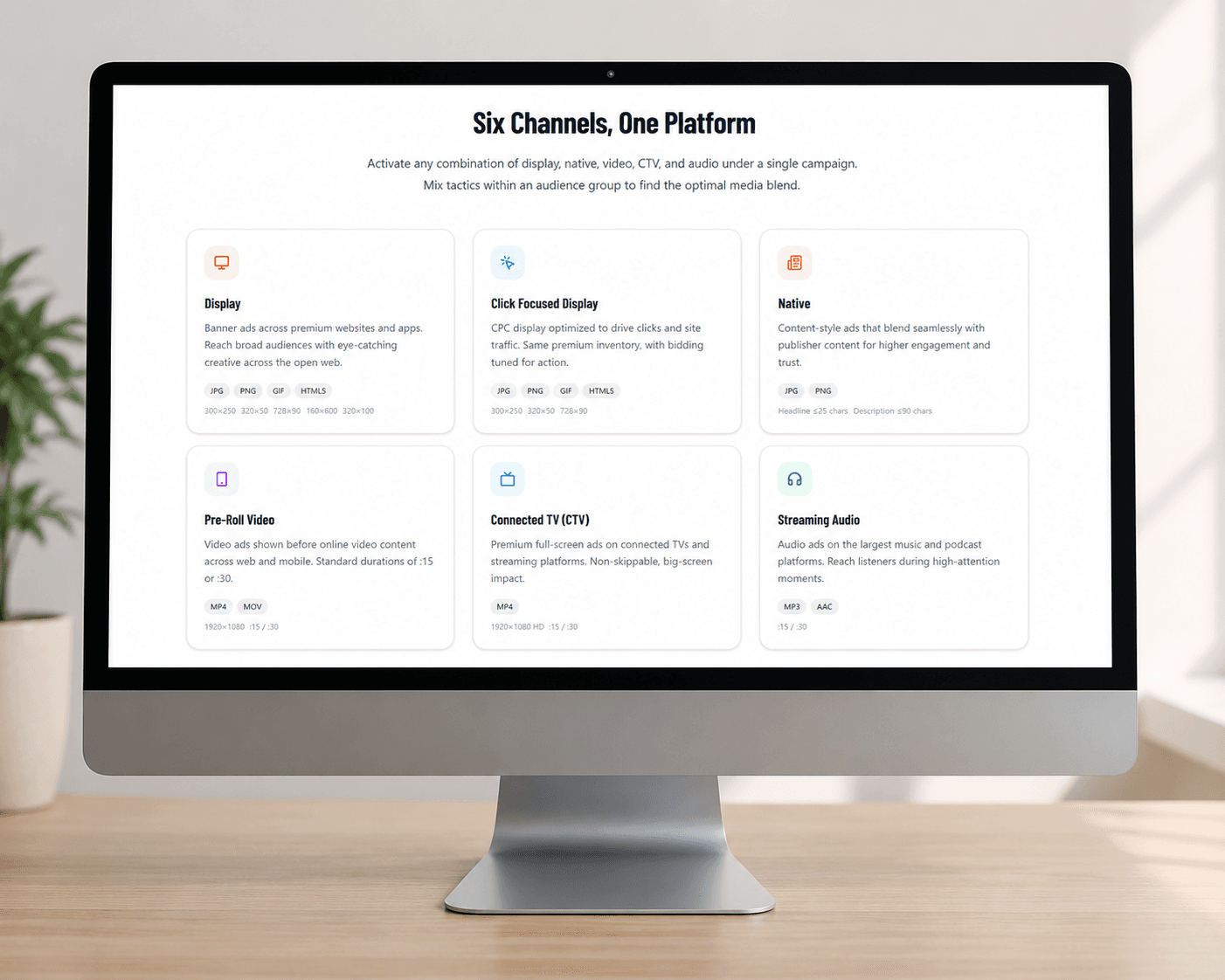
The Manifold campaign wizard treats audio as two distinct tactics — streaming audio for music and on-demand audio platforms, and audio as part of podcast and ad-supported network buys handled through our DSP integrations.
Once a campaign brief is in, the wizard sorts available tactics by how well each one fits the primary goal. Audio surfaces near the top for awareness, consideration, and CPG-style purchase campaigns; it is correctly de-prioritized when the brief is a pure click campaign where display or search will move the needle faster.
The audience layer is shared with every other tactic. Segments, first-party CRM uploads, contextual keywords, geo selections, frequency caps, dayparts, and device controls — including smart-speaker targeting — apply the same way they do to display or CTV. You build the audience once; the wizard activates it across every channel the campaign uses.
Behind the scenes, Manifold orchestrates audio buys across Spotify, the Yahoo DSP audio inventory, podcast networks accessible programmatically, and partner-network ad-supported audio. Per-tactic creative requirements are surfaced at the upload step — different specs for 15-, 30-, and 60-second audio spots, and slots for video and display companion units where the platform supports them. If your team does not produce audio in-house, the creative help request inside the same step lets the Manifold studio team take the brief and produce the spots.
Measurement is unified with the rest of the campaign. Audio impressions, completed listens, and downstream metrics flow into the same dashboard as every other tactic — so the cost-per-outcome comparison across audio, display, CTV, and search is on one screen rather than spread across six.
A Last Thought#
If your media plan has not had an audio line on it in the last twelve months, the most likely reason is not that audio does not work. It is that everyone is busy, the channel feels unfamiliar, and the team has defaulted to what they already know.
That is a fixable problem. Audio reaches your audience in the parts of the day no other channel can. The targeting is now competitive with anything you would do on display or CTV. The creative formats are well-established and the in-house production resources on the major platforms are excellent. Measurement, when the campaign is designed for it, holds up.
The brands using audio well in 2026 are not doing anything exotic. They are putting a thoughtful percentage of budget into the channel, building creative that respects the listener's moment, and treating audio as a planned input rather than a leftover. That is a low-effort move with a meaningful upside, and the longer the rest of the market takes to wake up to it, the better the rates are for the brands that move first.
Curious what a planned audio mix would look like for your brand or your agency's roster? The Manifold team can walk through audience, tactic, and creative options against the actual campaign goals you are working toward.